
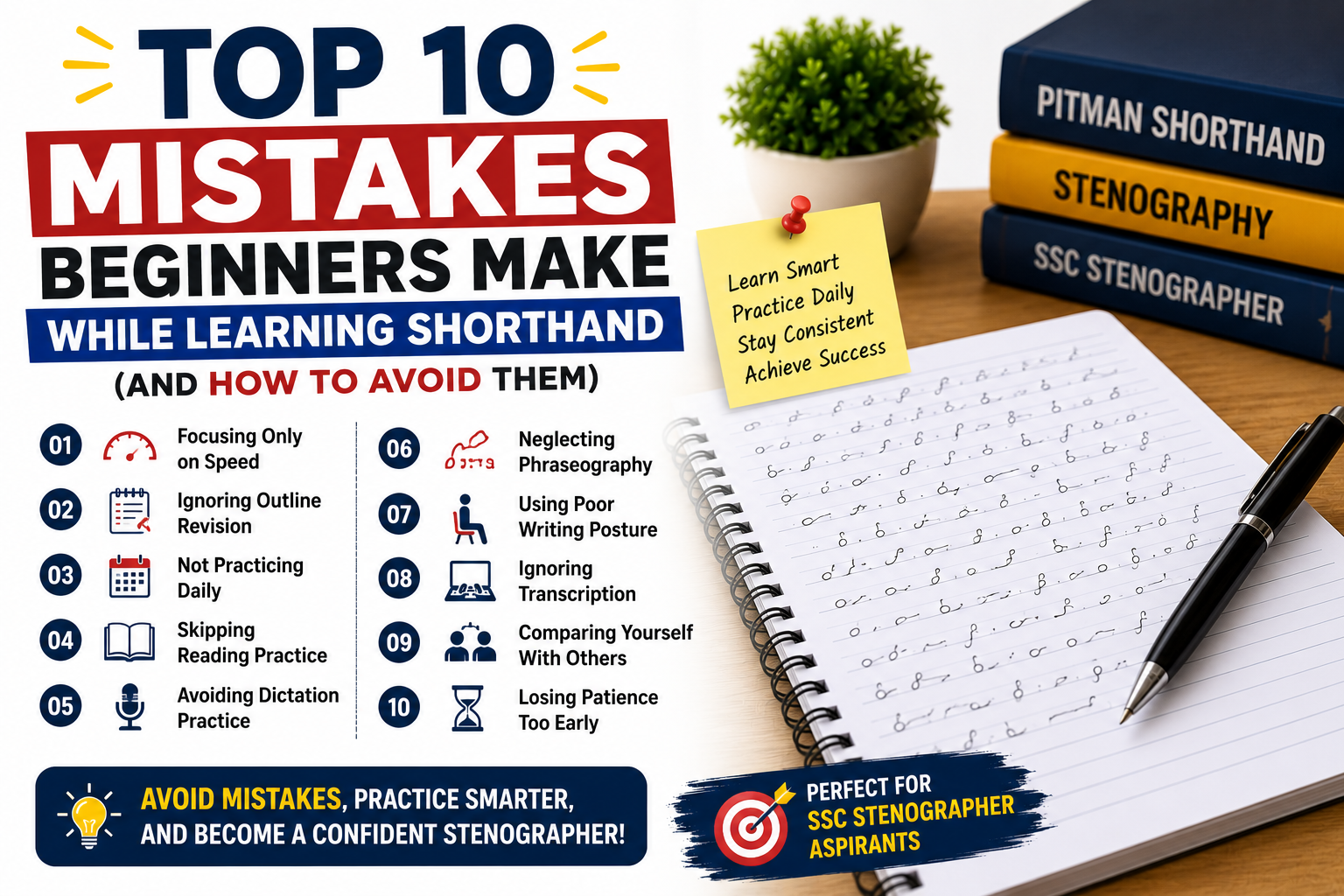
Top 10 Mistakes Beginners Make While Learning Shorthand (And How to Avoid Them)
Learning shorthand is an exciting journey, especially for students preparing for SSC Stenographer, Court Stenographer, and various government stenography examinations. However, many beginners struggle during the initial stages because they unknowingly develop habits that slow down their progress.
The good news is that most shorthand mistakes are easy to correct once you identify them. By avoiding common errors and following the right learning strategy, you can improve your speed, accuracy, and confidence much faster.
In this article, we will discuss the top 10 mistakes beginners make while learning shorthand and practical ways to avoid them.
1. Focusing Only on Speed
One of the most common mistakes is trying to write fast from the very beginning.
Many students see experienced stenographers writing at 100 WPM or more and immediately try to match that speed. This often leads to poor outlines, unclear notes, and reduced accuracy.
How to Avoid It
Focus on:
- Correct stroke formation
- Clear outlines
- Proper positioning
Remember, speed naturally develops when your fundamentals become strong.
2. Ignoring Outline Revision
Many beginners learn new outlines every day but rarely revise old ones.
As a result, previously learned outlines are forgotten, making dictation difficult.
How to Avoid It
Spend at least 15–20 minutes daily revising:
- Common words
- Frequently used phrases
- Previously learned outlines
Regular revision strengthens memory and improves writing speed.
3. Not Practicing Daily
Shorthand is a skill-based subject. Missing practice for several days can significantly affect progress.
Many students practice only when they feel motivated.
How to Avoid It
Create a fixed daily schedule.
Even:
- 30 minutes daily
is better than:
- 4 hours once a week
Consistency is more important than long study sessions.
4. Skipping Reading Practice
Most students only focus on writing and completely ignore reading shorthand notes.
This creates difficulty during transcription and reduces outline recognition.
How to Avoid It
Read your shorthand notes daily.
Benefits include:
- Better outline recognition
- Improved memory
- Faster transcription
- Greater confidence
Reading is just as important as writing.
5. Avoiding Dictation Practice
Some beginners spend months learning theory but never take actual dictations.
Without dictation practice, speed development becomes impossible.
How to Avoid It
Start taking dictations as soon as basic outlines are learned.
Begin with:
- Slow speed dictations
- Short passages
Gradually increase difficulty over time.
6. Neglecting Phraseography
Phraseography allows multiple words to be written using a single outline.
Many students ignore this important concept and continue writing every word separately.
How to Avoid It
Learn common phrases such as:
- There is
- It is
- We have
- In order to
- As a result
Phraseography can significantly increase shorthand speed.
7. Using Poor Writing Posture
Incorrect posture affects hand movement and causes fatigue during long dictations.
Many students:
- Bend excessively
- Hold the pen too tightly
- Sit uncomfortably
How to Avoid It
Maintain:
- Straight posture
- Relaxed shoulders
- Comfortable writing position
A relaxed hand writes faster and more accurately.
8. Ignoring Transcription Practice
Some students believe shorthand writing alone is enough.
However, SSC and other stenography exams also test transcription ability.
How to Avoid It
Practice transcription regularly.
Benefits:
- Improves note readability
- Enhances typing speed
- Builds exam confidence
- Identifies weak outlines
Daily transcription can greatly improve overall performance.
9. Comparing Yourself With Others
Many beginners become discouraged after comparing themselves with advanced students.
This often leads to frustration and loss of motivation.
How to Avoid It
Focus on your personal progress.
Track:
- Weekly speed improvement
- Accuracy percentage
- Outline retention
Everyone learns at a different pace.
10. Losing Patience Too Early
Perhaps the biggest mistake is expecting instant results.
Shorthand is not mastered in a few weeks.
Many students quit before seeing meaningful improvement.
How to Avoid It
Understand that shorthand is a long-term skill.
Progress may be slow initially, but consistent practice produces excellent results over time.
Stay patient and trust the learning process.
Bonus Tip: Keep an Error Notebook
Maintain a notebook for:
- Difficult outlines
- Frequently missed words
- Dictation mistakes
- Transcription errors
Reviewing these mistakes regularly helps prevent repetition and accelerates improvement.
Conclusion
Learning shorthand successfully requires more than just hard work—it requires the right approach. By avoiding common mistakes such as neglecting revision, skipping dictation, focusing only on speed, and ignoring transcription practice, beginners can build a strong foundation and improve much faster.
Remember, shorthand is a skill that rewards consistency. Practice daily, revise regularly, stay patient, and focus on gradual improvement. With dedication and proper guidance, you can steadily increase your shorthand speed and move closer to achieving your goal of becoming a successful stenographer.
Whether you are preparing for SSC Stenographer, Court Stenographer, or any other stenography examination, avoiding these common mistakes can make your journey smoother and more successful.