SSC Stenographer Preparation Strategy 2026 – Complete 6 Month Study Plan
The SSC Stenographer Exam is one of the most popular government job exams for students who want a stable career with an attractive salary, job security, and promotion opportunities.
Every year, thousands of candidates appear for the exam, but only those with a proper preparation strategy clear both the Computer-Based Test (CBT) and the Skill Test.
If you are planning to appear for the SSC Stenographer 2026 Exam, this detailed 6-month roadmap will help you prepare effectively from the basics to the final exam.
In this guide, you will learn:
- SSC Stenographer Exam Pattern
- 6-Month Preparation Plan
- Daily Study Routine
- Shorthand Practice Strategy
- Typing Improvement Tips
- Best Books
- Common Mistakes to Avoid
- Expert Tips for Selection
About SSC Stenographer Exam
The Staff Selection Commission (SSC) conducts the SSC Stenographer Examination to recruit candidates for:
- Grade C Stenographer
- Grade D Stenographer
Selected candidates work in various Central Government Ministries, Departments, Constitutional Bodies, and Government Offices.
It is considered one of the best career options for students who have completed Class 12.
SSC Stenographer Selection Process
The selection process consists of two stages.
Stage 1: Computer-Based Examination (CBT)
The objective paper contains three sections:
General Intelligence & Reasoning
Topics include:
- Analogy
- Coding-Decoding
- Series
- Blood Relation
- Direction
- Puzzle
- Non-Verbal Reasoning
General Awareness
Questions are asked from:
- History
- Geography
- Indian Polity
- Economics
- Science
- Current Affairs
- Static GK
- Government Schemes
English Language
Topics include:
- Grammar
- Vocabulary
- Synonyms
- Antonyms
- Comprehension
- Error Detection
- Sentence Improvement
- Cloze Test
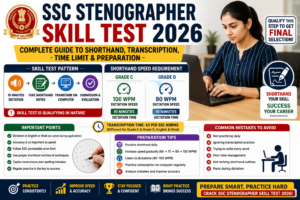
Stage 2: Skill Test
Candidates who qualify the CBT appear for the Skill Test.
This includes:
- Shorthand Dictation
- Transcription on Computer
This stage is qualifying in nature but extremely important.
6-Month Preparation Strategy
Month 1 – Build Strong Fundamentals
The first month should focus on understanding the basics.
Shorthand
- Learn Pitman Theory
- Practice alphabets
- Learn vowels
- Consonants
- Basic outlines
English
- Improve vocabulary
- Read newspaper daily
- Learn grammar basics
General Awareness
Study:
- Indian History
- Geography
- Constitution
Typing
Start with:
20–25 WPM
Practice for 20 minutes daily.
Month 2 – Start Regular Practice
Increase shorthand practice.
Target:
40–50 WPM
Daily routine:
- One dictation
- Outline revision
- Reading shorthand notes
English:
Start solving previous SSC English questions.
GK:
Current Affairs
Reasoning:
Practice one topic daily.
Typing:
Increase speed to 30–35 WPM.
Month 3 – Improve Speed
Now focus on speed building.
Target:
60–70 WPM
Daily Dictation:
20 minutes
Transcription:
20 minutes
Typing:
40 WPM
English:
Daily comprehension practice.
Reasoning:
Mock tests twice a week.
GK:
Monthly current affairs revision.
Month 4 – Exam-Oriented Preparation
Target shorthand speed:
80 WPM
Start:
- Full-length mock tests
- Previous Year Papers
- Timed practice
Typing:
45–50 WPM
Focus on:
Accuracy over speed.
Month 5 – Advanced Practice
Target shorthand speed:
100 WPM
Daily Routine
Morning
Theory Revision
Afternoon
Typing Practice
Evening
Live Dictation
Night
Mock Test Analysis
Solve SSC previous year papers every alternate day.
Month 6 – Final Revision
This month is only for revision.
Do not learn anything new.
Practice:
- Daily dictation
- Full CBT mock
- Typing
- Error correction
Attempt one complete mock every day.
Daily Study Routine (4–5 Hours)
Morning (1 Hour)
Shorthand Theory
Revision
Afternoon (1 Hour)
English
Vocabulary
Grammar
Evening (1 Hour)
Shorthand Dictation
Transcription
Night (1 Hour)
Reasoning
GK
Mock Test
Best Books for SSC Stenographer
English
- Objective General English by S.P. Bakshi
- Plinth to Paramount
General Awareness
- Lucent General Knowledge
- Monthly Current Affairs Magazine
Reasoning
- R.S. Aggarwal Verbal & Non-Verbal Reasoning
Shorthand
- Pitman Shorthand Instructor
- Previous SSC Dictation Booklets
- Institute Practice Notes
Typing Improvement Tips
Typing plays an important role during transcription.
Follow these tips:
- Practice daily
- Learn touch typing
- Use all fingers
- Maintain proper posture
- Don’t look at the keyboard
- Focus on accuracy first
Target typing speed:
40–50 WPM
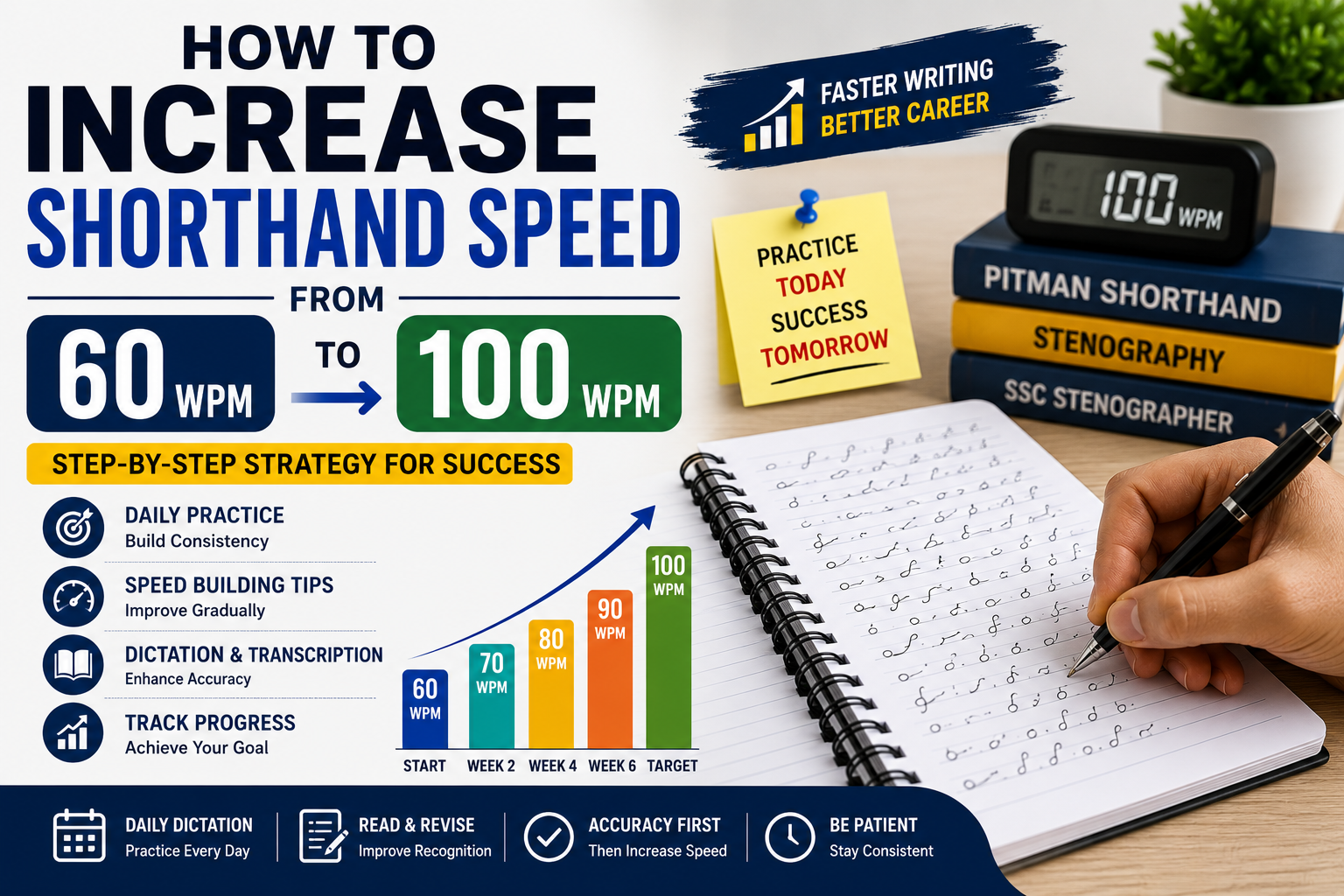
Shorthand Speed Improvement Tips
To improve your shorthand speed:
- Practice daily without skipping.
- Read your old notes regularly.
- Increase speed gradually.
- Record dictations and replay them.
- Practice difficult outlines repeatedly.
- Maintain a separate notebook for mistakes.
- Revise theory every week.
Remember:
Consistency is more important than long study hours.
Common Mistakes Students Make
Many aspirants fail because of avoidable mistakes.
Some common mistakes are:
- Ignoring shorthand practice
- Focusing only on the written exam
- Skipping theory
- Not revising outlines
- No mock test practice
- Poor typing speed
- Inconsistent study schedule
Avoiding these mistakes can significantly improve your chances of selection.
Expert Tips for SSC Stenographer 2026
- Study every day without long breaks.
- Solve previous year question papers.
- Give weekly mock tests.
- Improve English vocabulary daily.
- Read newspapers regularly.
- Practice shorthand at the same time every day.
- Track your speed every week.
- Focus on accuracy before speed.
Career Opportunities After Selection
After qualifying SSC Stenographer, candidates can work in:
- Central Government Ministries
- Parliament
- Supreme Court
- Government Departments
- Defence Offices
- Income Tax Department
- CBI
- CAG
- Railways
- Constitutional Bodies
With experience and departmental promotions, candidates can move to higher administrative positions and enjoy excellent long-term career growth.