SSC Stenographer Grade C vs Grade D – Difference, Salary, Promotion & Which is Better? (2026 Guide)
If you’re preparing for the SSC Stenographer Exam 2026, one of the biggest questions is:
Should I target Grade C or Grade D?
Both are Central Government jobs with good salary, job security, pension benefits, and promotion opportunities. However, there are significant differences in salary, work profile, promotion, responsibility, and career growth.
In this guide, we’ll compare SSC Stenographer Grade C vs Grade D in detail so you can decide which post is the best fit for your career.
Quick Comparison
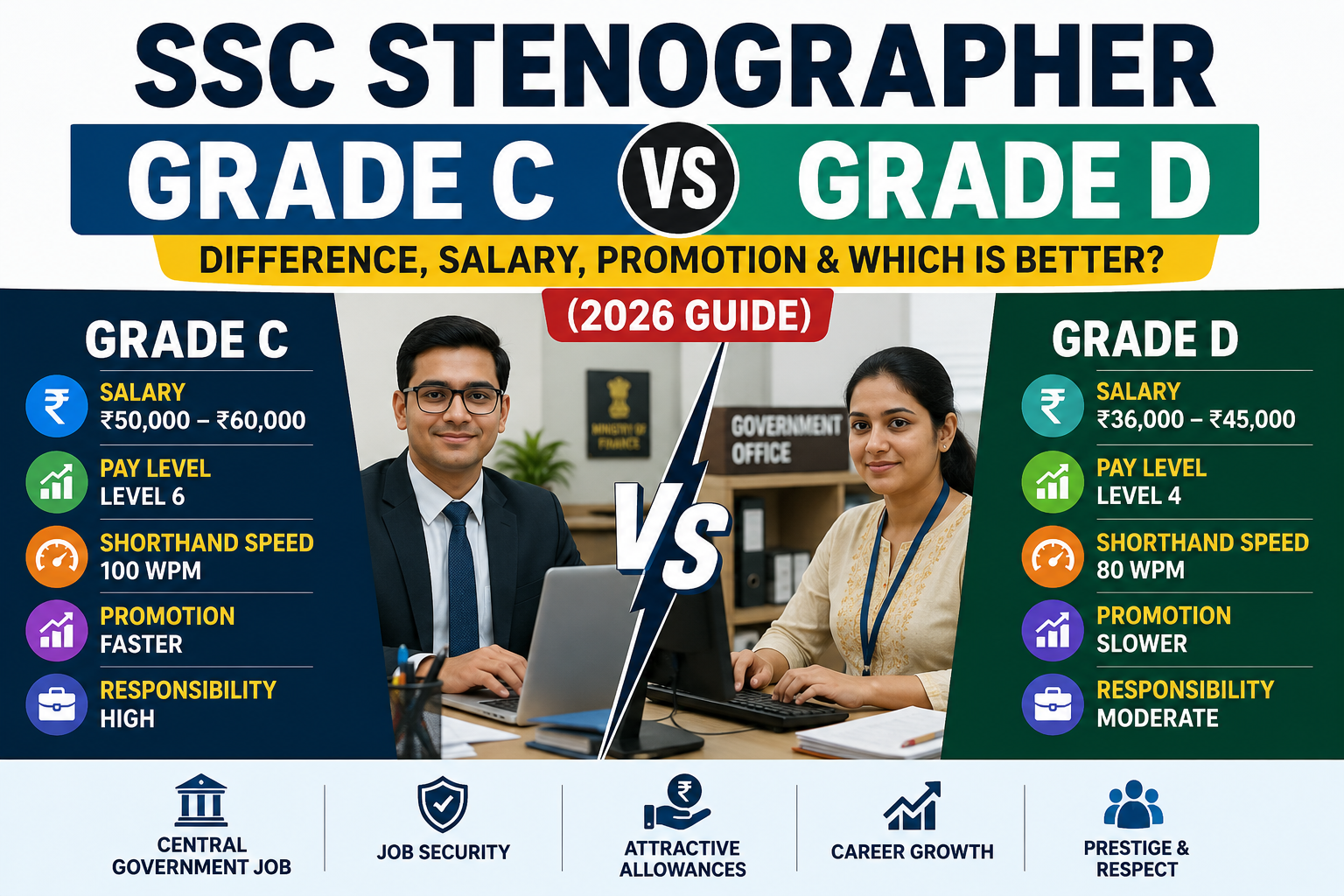
| Feature | Grade C | Grade D |
|---|---|---|
| Pay Level | Level 6 | Level 4 |
| Basic Pay | ₹35,400 | ₹25,500 |
| Approx. In-Hand Salary | ₹50,000–₹60,000 | ₹36,000–₹45,000 |
| Shorthand Speed | 100 WPM | 80 WPM |
| Responsibility | High | Moderate |
| Career Growth | Faster | Moderate |
| Work Pressure | Higher | Lower |
| Promotion | Faster | Slower |
| Best For | Long-term career | Easy government entry |
Salary varies depending on city, HRA category, and department.
What is SSC Stenographer Grade C?
Grade C Stenographers generally work in:
- Central Ministries
- Government Departments
- Constitutional Bodies
- Headquarters Offices
- Senior Officers’ Offices
They handle:
- Confidential correspondence
- Official meetings
- Speech dictation
- Government reports
- High-level documentation
This role comes with greater responsibility but also offers better career growth.
What is SSC Stenographer Grade D?
Grade D Stenographers usually work in:
- Attached Offices
- Subordinate Offices
- Government Departments
- Regional Offices
Their responsibilities include:
- Typing dictation
- File maintenance
- Office correspondence
- Administrative assistance
- Routine stenography work
The workload is generally lighter compared to Grade C.
Salary Comparison (2026)
Grade C Salary
- Basic Pay: ₹35,400
- Pay Level: Level 6
- Approx. In-Hand Salary:
- ₹50,000–₹60,000 per month
Includes:
- Dearness Allowance (DA)
- House Rent Allowance (HRA)
- Transport Allowance (TA)
- Medical Benefits
- NPS
- Leave Benefits
Grade D Salary
- Basic Pay: ₹25,500
- Pay Level: Level 4
- Approx. In-Hand Salary:
- ₹36,000–₹45,000 per month
The difference in monthly take-home salary is often around ₹14,000–₹16,000, depending on posting and allowances.
Eligibility Difference
Both posts require:
- 12th Pass
- Indian Citizen
- Computer-Based Examination
- Skill Test
Main Difference
| Grade | Shorthand Speed |
|---|---|
| Grade C | 100 WPM |
| Grade D | 80 WPM |
The typing/transcription standards also differ according to SSC rules.
Promotion Opportunities
Grade C Promotion
Typical progression:
- Stenographer Grade C
- Personal Assistant (PA)
- Private Secretary (PS)
- Senior Private Secretary
- Principal Private Secretary
Promotions depend on:
- Seniority
- Departmental Exams
- Performance
- Vacancies
Grade D Promotion
Typical progression:
- Stenographer Grade D
- Grade C
- Personal Assistant
- Private Secretary
Grade D employees can eventually reach Grade C through departmental promotion, but it generally takes longer.
Job Responsibilities
Grade C
- High-level meetings
- Confidential files
- Cabinet notes
- Ministerial communication
- Official speeches
- Important government records
Grade D
- Routine office work
- Typing
- Dictation
- File movement
- Office communication
- Administrative support
Posting Locations
Grade C
Usually posted in:
- Delhi
- Central Government Headquarters
- Major Ministries
- National Offices
Grade D
Can be posted anywhere in India:
- Regional Offices
- Field Offices
- State-level Government Departments
- Attached Offices
Grade D offers wider posting locations, while Grade C often provides greater exposure to central administration.
Work Pressure
Grade C
Pros
- Better exposure
- Senior officers
- Faster promotions
- Better networking
Cons
- Higher responsibility
- Busy schedules
- Tight deadlines
Grade D
Pros
- Better work-life balance
- Less pressure
- Routine work
- Stable office timings
Cons
- Slower career growth
- Lower salary
Which Grade is Better?
Choose Grade C If
✔ You want a higher salary.
✔ You want faster promotions.
✔ You enjoy challenging work.
✔ You aim for senior administrative roles.
✔ You’re comfortable with higher shorthand speed.
Choose Grade D If
✔ You want to enter government service sooner.
✔ You prefer a better work-life balance.
✔ You are still improving your shorthand speed.
✔ You prefer less stressful office work.
Grade C vs Grade D – Pros & Cons
Grade C
Pros
- Higher salary
- Better promotions
- Better offices
- Higher status
- More exposure
Cons
- More work pressure
- Higher shorthand requirement
- Greater responsibility
Grade D
Pros
- Easier shorthand requirement
- Better work-life balance
- Stable government job
- Lower work pressure
Cons
- Lower salary
- Slower promotions
- Less administrative exposure
Frequently Asked Questions (FAQs)
Is Grade C better than Grade D?
Yes. Grade C offers a higher salary, faster promotions, and more prestigious postings. However, it also comes with greater responsibility and a higher shorthand speed requirement.
Can Grade D become Grade C?
Yes. Grade D Stenographers can be promoted to Grade C through departmental promotion and seniority, subject to vacancies and rules.
Which has a better salary?
Grade C receives a significantly higher salary than Grade D because it is placed at Pay Level 6 instead of Pay Level 4.
Which has better work-life balance?
Grade D generally provides a more predictable routine and better work-life balance, while Grade C may involve higher workloads.
Is the exam different?
No. Both posts are recruited through the SSC Stenographer Examination, but the required shorthand speed differs (100 WPM for Grade C and 80 WPM for Grade D).
Final Verdict
If your goal is maximum salary, faster promotions, and long-term career growth, SSC Stenographer Grade C is the better choice.
If your priority is getting a secure Central Government job quickly with a lighter workload, SSC Stenographer Grade D is an excellent option.
Both posts provide attractive salaries, government benefits, pension-related advantages, job security, and opportunities to build a rewarding career in the Central Government. The right choice ultimately depends on your career goals, shorthand proficiency, and preferred work environment.

You may also like