History of Shorthand: When and Who Invented Shorthand?
Shorthand, also known as stenography, is a writing technique used to record spoken words quickly and efficiently. It has played an important role in journalism, courts, offices, administration, and government services for centuries.
Where Did Shorthand Originate?
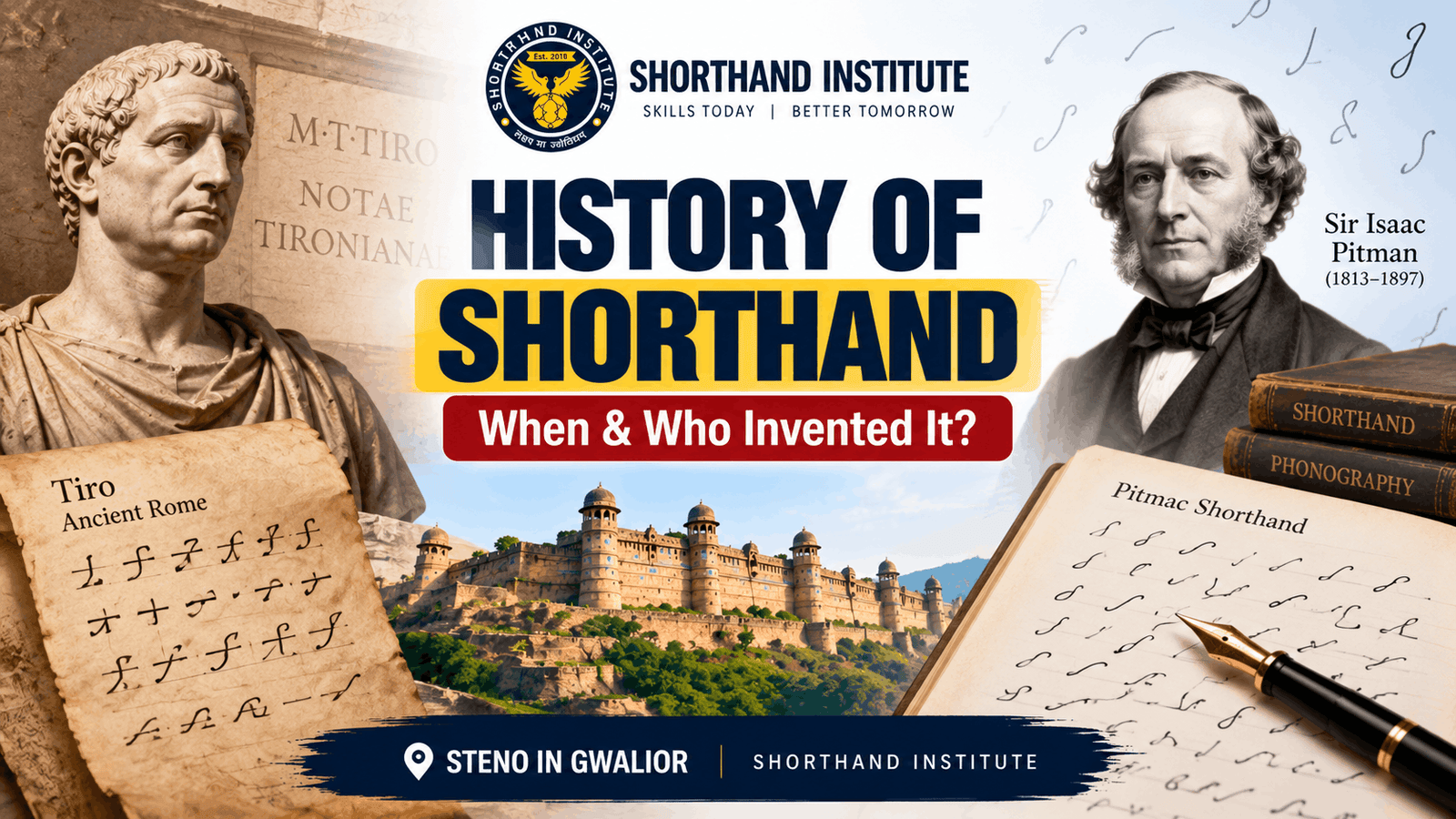
The history of shorthand goes back to ancient Rome. One of the earliest well-known shorthand systems was developed by Marcus Tullius Tiro, a secretary and former slave associated with the Roman statesman Cicero.
Tiro created a system known as Tironian Notes, which used special symbols and abbreviations to record speeches and other spoken content more quickly than normal writing.
Who Invented Modern Shorthand?
Although shorthand existed long before modern times, Sir Isaac Pitman is widely regarded as one of the most important figures in the development of modern English shorthand.
In 1837, Isaac Pitman introduced his phonetic shorthand system, initially called “Stenographic Sound-Hand.” The system later became known as Pitman Shorthand or Phonography.
Unlike ordinary writing, Pitman’s system was based primarily on speech sounds. Different strokes and symbols represented different sounds, allowing trained writers to record spoken language at much higher speeds.
How Did Pitman Shorthand Become Popular?
Pitman Shorthand became popular because it provided an efficient way to record speech. It was particularly useful for:
- Court reporting
- Journalism
- Office work
- Secretarial jobs
- Government departments
- Parliamentary reporting
- Business communication
As demand for fast and accurate note-taking increased, shorthand became an important professional skill.
Shorthand Before Isaac Pitman
Isaac Pitman did not develop his system completely in isolation. Earlier shorthand systems had already been created and improved by various writers.
One important predecessor was Samuel Taylor, who published his shorthand system in 1786. Pitman studied earlier shorthand methods and developed a new system with a strong focus on phonetics and speed.
Shorthand in India
Shorthand later became an important skill in India, particularly for government offices, courts, public-sector organisations and administrative departments. English and Hindi shorthand continue to be relevant for candidates preparing for various stenographer and government recruitment examinations.
Today, students learn shorthand alongside typing and transcription, as these skills are often essential for stenography-related careers.
Why Is Shorthand Still Important?
Even with modern technology, shorthand remains valuable wherever accurate and rapid recording of speech is required. A skilled stenographer can listen, understand and write information simultaneously while maintaining speed and accuracy.
For students preparing for stenographer exams, developing shorthand speed gradually through regular dictation practice is essential.
Learn Stenography in Gwalior
If you are looking for stenography classes in Gwalior, shorthand classes in Gwalior, or professional stenography training in Gwalior, proper guidance and consistent practice can help you build strong shorthand, typing and transcription skills.
Shorthand Institute, Gwalior provides training focused on developing practical stenography skills for students and job aspirants.
📍 Thatipur, Gwalior (M.P.)
📞 +91 9516744498
Conclusion
The history of shorthand spans thousands of years, from Tiro’s shorthand in ancient Rome to the development of modern systems such as Pitman Shorthand. Sir Isaac Pitman’s work in 1837 was a major milestone that transformed shorthand into a widely used professional skill.
If you want to build a career in stenography, start with the basics, practice shorthand every day, and gradually work towards higher speed and accuracy.