SSC Stenographer Skill Test Preparation Strategy 2026 (Complete Guide)
The SSC Stenographer examination is one of the most popular government job exams in India. Every year, thousands of candidates apply for Stenographer Grade C and Grade D posts, but many candidates fail to qualify in the Skill Test despite clearing the written examination.
The reason is simple: while candidates prepare extensively for the written exam, they often neglect shorthand practice and transcription skills. The Skill Test is the most important stage of the selection process and requires dedicated preparation.
In this guide, we will discuss a complete SSC Stenographer Skill Test preparation strategy for 2026.
Understanding the SSC Stenographer Skill Test
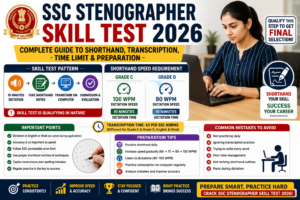
After qualifying the Computer-Based Examination, candidates must appear for the Skill Test.
The test evaluates:
- Shorthand speed
- Listening ability
- Accuracy
- Transcription skills
- Time management
Candidates are required to take a dictation passage and then transcribe it on a computer within the prescribed time limit.
Required Speed for SSC Stenographer
Grade D
- English: 80 WPM
- Hindi: 80 WPM
Grade C
- English: 100 WPM
- Hindi: 100 WPM
Candidates should aim for at least 10–15 WPM above the required speed during practice to remain comfortable during the actual examination.
Create a Daily Practice Schedule
A successful stenographer follows a disciplined routine.
Morning (30 Minutes)
- Outline revision
- Reading shorthand notes
- Phrase practice
Afternoon (45 Minutes)
- Dictation practice
- Accuracy improvement
Evening (45 Minutes)
- Speed practice
- Transcription exercise
Practicing daily is far more effective than studying for several hours only on weekends.
Master Common Outlines
Many words frequently appear in government dictations.
Examples:
- Government
- Department
- Administration
- Development
- Education
- Employment
- Committee
Students should create a notebook of frequently used outlines and revise them regularly.
Importance of Phraseography
Phraseography allows multiple words to be written using a single outline.
Examples:
- There is
- It is
- We have
- As a result
- In order to
Using phraseography correctly can improve both speed and accuracy.
Improve Listening Skills
Many candidates lose marks because they cannot catch words properly during dictation.
To improve listening skills:
- Listen to English and Hindi news daily.
- Practice with recorded dictations.
- Increase dictation speed gradually.
- Avoid pausing recordings frequently.
Good listening skills significantly improve shorthand performance.
Practice Transcription Daily
Transcription is equally important as shorthand writing.
Many candidates write well but fail during transcription due to:
- Poor readability
- Spelling mistakes
- Typing errors
- Lack of computer practice
Spend at least 20–30 minutes daily transcribing shorthand notes.
Avoid Common Mistakes
Students often make these mistakes:
❌ Practicing only theory
❌ Ignoring transcription
❌ Jumping directly to higher speeds
❌ Not revising outlines
❌ Inconsistent practice
Avoiding these mistakes can dramatically improve your performance.
Take Mock Skill Tests
Mock tests help simulate real exam conditions.
Benefits include:
- Better time management
- Reduced exam anxiety
- Improved accuracy
- Faster transcription
Try to take one full skill test every week.
Conclusion
SSC Stenographer Skill Test preparation requires consistent practice, proper planning, and patience. Focus on shorthand speed, transcription, phraseography, and listening skills. With regular practice and the right strategy, qualifying the SSC Stenographer Skill Test 2026 becomes much easier.
Start preparing today, stay consistent, and move closer to your dream government job.