How to Increase Shorthand Speed from 60 WPM to 100 WPM
Shorthand is one of the most important skills for students preparing for SSC Stenographer, State Stenographer, Court Stenographer, and various government stenography exams. While many students learn shorthand basics quickly, increasing speed from 60 Words Per Minute (WPM) to 100 WPM often becomes the biggest challenge.
The good news is that improving shorthand speed is not about learning new outlines every day. It is mainly about consistent practice, proper dictation, regular revision, and developing writing accuracy. If you are currently writing at 60 WPM and want to reach 100 WPM, this guide will help you understand the right approach.
Why is 100 WPM Important?
Many government stenographer examinations require candidates to achieve high shorthand speeds. A speed of 100 WPM not only improves your chances of qualifying in skill tests but also makes transcription easier and more accurate.
Students who can comfortably write at 100 WPM generally find exam dictations less stressful and can focus more on accuracy rather than struggling to keep up with the speaker.
Understand the Difference Between Speed and Accuracy
One of the biggest mistakes students make is focusing only on speed. Writing faster without accuracy creates confusion during transcription.
Before trying to increase speed, ensure that:
- Basic strokes are clear.
- Outlines are correctly formed.
- Common words are written consistently.
- Reading back your notes is easy.
Remember, speed without accuracy is of little use in shorthand examinations.
Build a Daily Practice Routine
Consistency is the key to shorthand improvement. Instead of practicing for long hours once a week, practice every day.
A recommended daily schedule:
Morning Session (30 Minutes)
- Revision of previous outlines
- Reading shorthand notes
- Practice common phrases
Afternoon Session (30 Minutes)
- Dictation at comfortable speed
- Focus on accuracy
Evening Session (45 Minutes)
- Speed practice
- Transcription practice
- Error correction
Even 1.5 to 2 hours of focused daily practice can significantly improve your speed within a few months.
Practice Dictation Every Day
Dictation practice is the most effective method for increasing speed.
Start with:
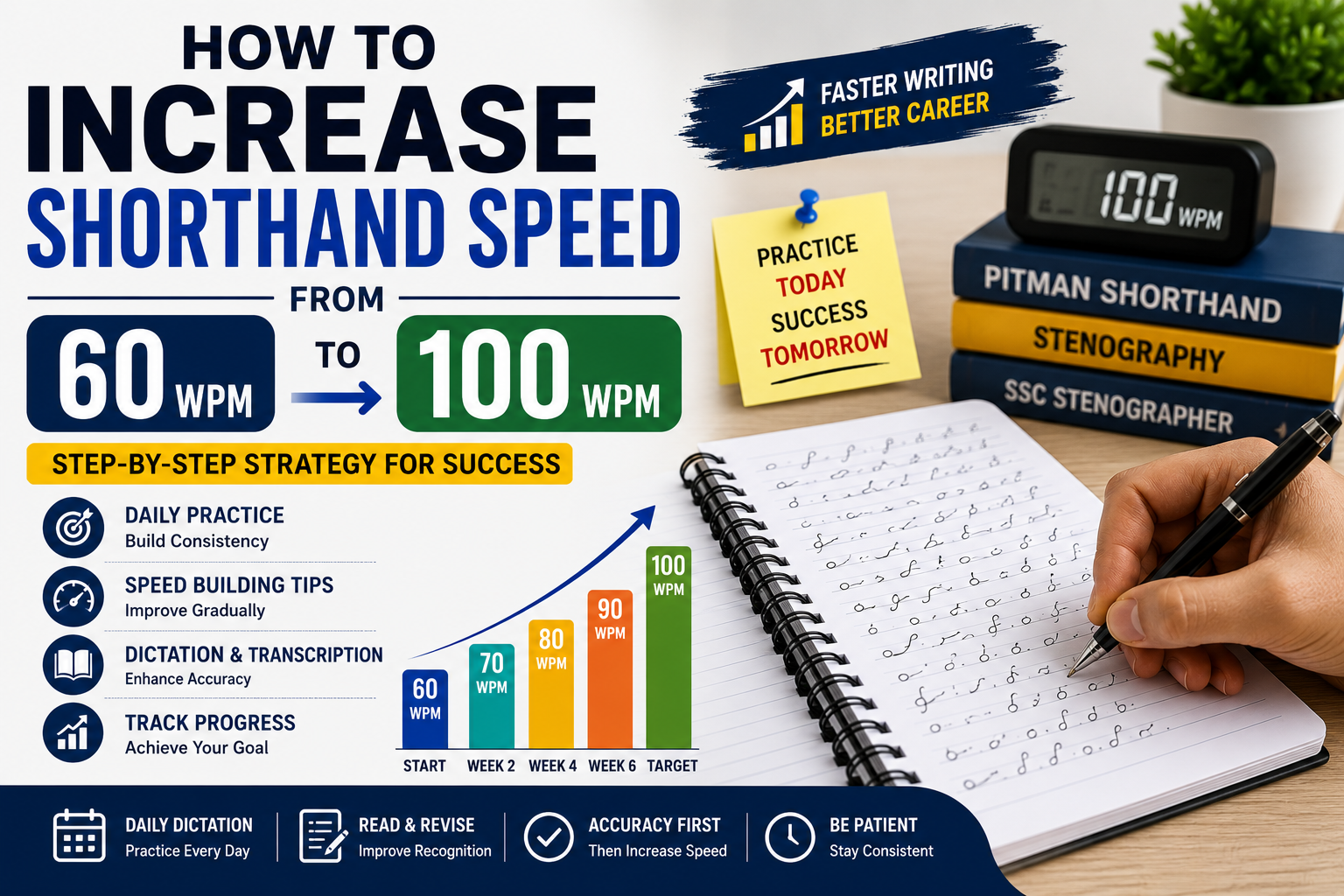
- 60 WPM
- Then move to 70 WPM
- Then 80 WPM
- Gradually increase to 90 WPM and 100 WPM
Do not jump directly from 60 WPM to 100 WPM. Gradual progression helps your hand and mind adapt naturally.
Record your own dictations or use practice materials specifically designed for stenography students.
Improve Word Recognition
When writing shorthand, you should recognize words instantly.
Many students waste time thinking about outlines during dictation.
To improve recognition:
- Read shorthand magazines regularly.
- Revise frequently used outlines.
- Practice government examination passages.
- Maintain a notebook of difficult words.
The more familiar you are with outlines, the faster your writing becomes.
Focus on Phraseography
Phraseography helps combine multiple words into a single shorthand outline.
Examples include:
- It is
- There is
- We have
- In the case of
- As soon as possible
Using phraseography correctly can significantly increase writing speed because fewer pen movements are required.
Students aiming for 100 WPM should devote special attention to mastering common phrases.
Read Your Notes Daily
Many learners only practice writing but rarely read their shorthand notes.
Reading shorthand improves:
- Outline recognition
- Memory retention
- Writing confidence
- Transcription speed
Spend at least 15–20 minutes every day reading old shorthand notes. This habit strengthens your overall shorthand ability.
Analyze Your Mistakes
After every dictation session:
- Check missed words.
- Identify unclear outlines.
- Find difficult phrases.
- Rewrite incorrect portions.
Keeping an error notebook is extremely useful. Review it weekly to avoid repeating the same mistakes.
Strengthen Hand Movement
Writing speed depends heavily on smooth hand movement.
To improve writing flow:
- Maintain proper posture.
- Hold the pen comfortably.
- Avoid excessive pressure on paper.
- Practice continuous writing exercises.
A relaxed hand can write much faster than a tense hand.
Practice Transcription Regularly
Many students focus entirely on dictation and ignore transcription.
Transcription helps:
- Identify weak areas
- Improve note readability
- Build exam confidence
- Increase overall accuracy
After every dictation session, transcribe your notes and compare them with the original passage.
Take Weekly Speed Tests
Track your progress every week.
For example:
Week 1
- 60 WPM
Week 3
- 70 WPM
Week 5
- 80 WPM
Week 8
- 90 WPM
Week 12
- 100 WPM
Progress may vary for each student, but regular testing helps measure improvement and keeps motivation high.
Stay Patient and Consistent
Reaching 100 WPM does not happen overnight. Most successful stenographers achieve this speed through months of disciplined practice.
Avoid comparing yourself with others. Focus on gradual improvement and maintain consistency.
Even if your speed increases by only 5 WPM each month, you will eventually reach your target.
Conclusion
Increasing shorthand speed from 60 WPM to 100 WPM is completely achievable with the right strategy. Daily dictation practice, regular revision, phraseography, transcription, and consistent error analysis are the keys to success.
Remember that accuracy should always come before speed. Build a strong foundation, practice every day, and gradually increase your dictation speed. With dedication and proper guidance, achieving 100 WPM shorthand speed becomes a realistic goal rather than a difficult challenge.
Whether you are preparing for SSC Stenographer, State Stenographer, Court Stenographer, or any other stenography examination, following these techniques can help you improve your performance and move one step closer to securing your dream government job.