SSC Stenographer Skill Test 2026 – Complete Guide to Shorthand, Transcription, Time Limit & Preparation
The SSC Stenographer Skill Test is the second stage of the recruitment process after the Computer-Based Examination (CBT). Candidates who qualify the written exam must pass the Skill Test to be considered for final selection.
Unlike the CBT, the Skill Test evaluates your shorthand dictation and transcription speed, making it a crucial step in the recruitment process.
In this guide, we’ll explain the complete SSC Stenographer Skill Test 2026, including shorthand speed requirements, transcription time, qualifying criteria, preparation strategy, and common mistakes to avoid.
SSC Stenographer Selection Process
The recruitment process consists of two stages:
Stage 1
- Computer-Based Examination (CBT)
Stage 2
- Skill Test (Qualifying)
Only candidates who clear the CBT are called for the Skill Test.
Is the Skill Test Qualifying?
Yes.
The Skill Test is qualifying in nature, which means the marks obtained are not added to the final merit list. However, candidates must qualify the test according to SSC standards to be eligible for final selection.
SSC Stenographer Skill Test Pattern 2026
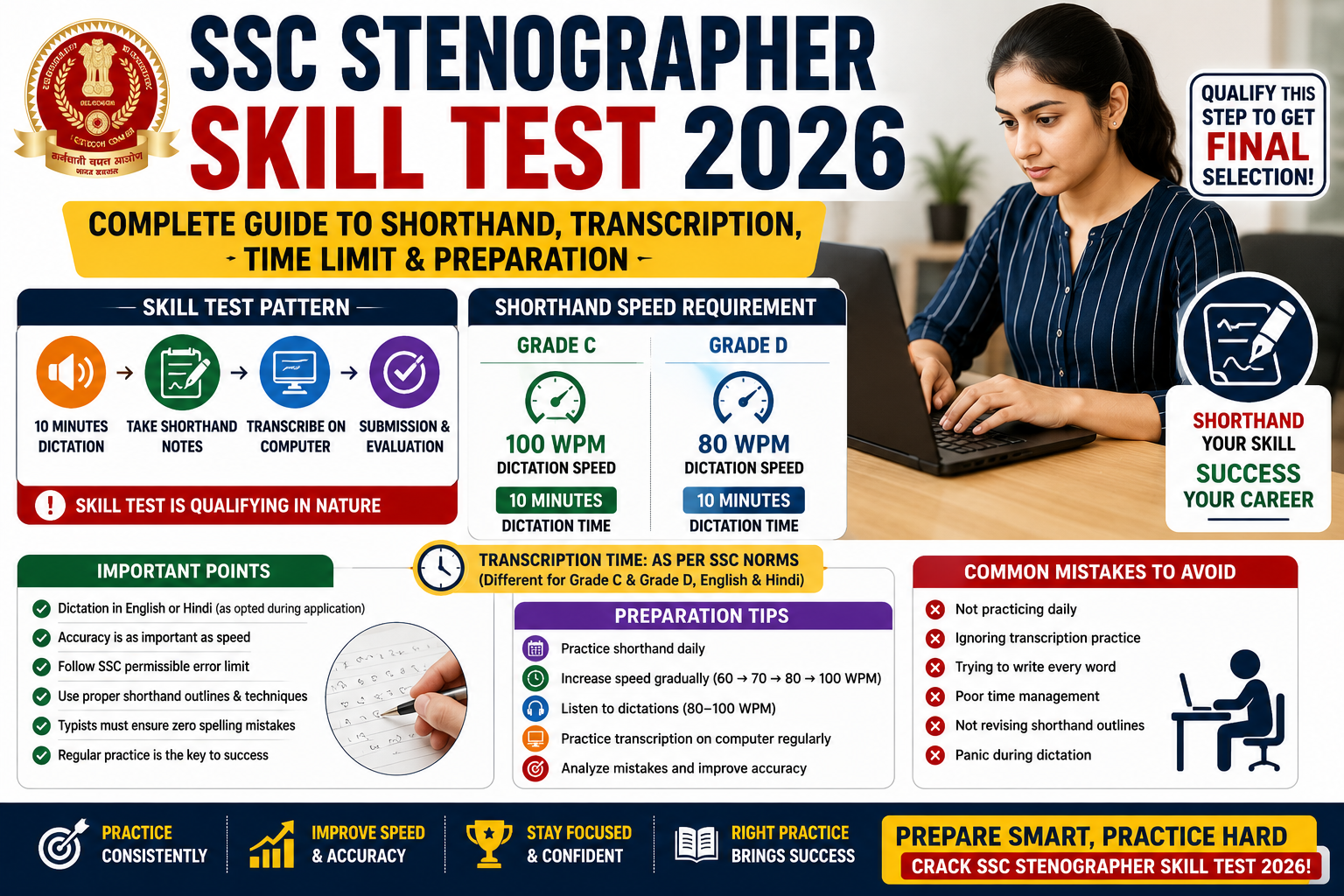
Candidates are given a 10-minute dictation in either English or Hindi, depending on the language chosen during the application process.
The dictated passage must then be transcribed on a computer within the prescribed time limit.
Shorthand Speed Requirement
Grade C
| Particular | Requirement |
|---|---|
| Dictation Speed | 100 Words Per Minute |
| Dictation Duration | 10 Minutes |
Grade D
| Particular | Requirement |
|---|---|
| Dictation Speed | 80 Words Per Minute |
| Dictation Duration | 10 Minutes |
The higher shorthand speed requirement makes the Grade C Skill Test more challenging than Grade D.
Transcription Time Limit
The time allowed for transcription depends on:
- Grade (C or D)
- Language chosen (English or Hindi)
SSC specifies separate transcription time limits for each category in the official notification issued every recruitment cycle. Candidates should always refer to the latest notification for the applicable timings.
What Happens During the Skill Test?
The Skill Test generally follows these steps:
- Verification of candidate identity.
- Seating at the computer system.
- Dictation of a passage for 10 minutes.
- Preparation of shorthand notes.
- Transcription of the notes on the computer.
- Submission of the typed transcript for evaluation.
Evaluation Criteria
SSC evaluates candidates based on:
- Accuracy of transcription
- Shorthand proficiency
- Typing accuracy
- Ability to complete within the prescribed time
- Adherence to permissible error limits (as specified by SSC)
The focus is not only on speed but also on maintaining accuracy.
Best Way to Prepare for the Skill Test
1. Practice Every Day
Daily shorthand practice helps improve:
- Speed
- Listening skills
- Accuracy
Even 30–60 minutes of consistent practice can make a significant difference.
2. Use a Stopwatch
Time your dictation sessions to simulate the actual examination environment and improve time management.
3. Increase Speed Gradually
Avoid trying to reach 100 WPM immediately.
A practical progression is:
- 60 WPM
- 70 WPM
- 80 WPM
- 90 WPM
- 100 WPM
Focus on maintaining accuracy while increasing speed.
4. Practice Transcription
Many candidates spend all their time on shorthand but neglect transcription.
Regular transcription practice improves:
- Typing speed
- Formatting
- Accuracy
- Confidence
5. Solve Previous Skill Test Passages
Practicing previous years’ dictation passages helps you become familiar with:
- Sentence structure
- Vocabulary
- Dictation pace
- Common examination patterns
Common Mistakes to Avoid
- Skipping daily shorthand practice
- Focusing only on typing speed
- Ignoring transcription practice
- Panicking during dictation
- Trying to write every word instead of using proper shorthand outlines
- Not revising shorthand symbols regularly
Tips to Improve Shorthand Speed
- Learn standard shorthand outlines thoroughly.
- Practice common words and phrases repeatedly.
- Listen to recorded dictations at different speeds.
- Review your mistakes after every practice session.
- Increase speed only after achieving good accuracy.
Recommended Resources
Shorthand Books
- Pitman Shorthand Instructor
- Pitman New Era Shorthand
Practice Material
- Previous Year SSC Skill Test Passages
- Daily Newspaper Editorial Dictation
- Recorded Dictation Audio (80–100 WPM)
Frequently Asked Questions (FAQs)
Is the SSC Stenographer Skill Test difficult?
The Skill Test can be challenging without regular practice, but candidates who practice shorthand and transcription consistently generally perform well.
What is the shorthand speed for Grade C?
Candidates must take dictation at 100 words per minute (WPM) for 10 minutes.
What is the shorthand speed for Grade D?
Candidates must take dictation at 80 words per minute (WPM) for 10 minutes.
Are Skill Test marks added to the merit list?
No. The Skill Test is qualifying in nature. However, qualifying it is mandatory for final selection.
How can I improve my shorthand speed?
Practice daily, revise shorthand outlines, take timed dictations, and regularly transcribe your notes on a computer to build both speed and accuracy.
Final Verdict
The SSC Stenographer Skill Test 2026 is a decisive stage in the recruitment process. While the written examination tests your knowledge, the Skill Test evaluates your ability to perform the core duties of a stenographer.
Success depends on consistent shorthand practice, accurate transcription, and effective time management. By practicing daily, reviewing your mistakes, and gradually increasing your speed, you can confidently qualify the Skill Test and move one step closer to securing a Central Government job as an SSC Stenographer.